


GI Bleeding Surgery
GI Bleeding Surgery
Gastrointestinal (GI) bleeding is when bleeding occurs in any part of the gastrointestinal tract. The GI tract includes your esophagus, stomach, small intestine, large intestine (colon), rectum, and anus. GI bleeding itself is not a disease, but a symptom of any number of conditions.
The causes and risk factors for gastrointestinal (GI) bleeding are classified into upper or lower, depending on their location in the GI tract.
Causes of upper GI bleeding include
- Peptic ulcer disease: Peptic ulcers are localized erosions of the mucosal lining of the digestive tract. Ulcers usually occur in the stomach or duodenum. Breakdown of the mucosal lining results in damage to blood vessels, causing abdominal bleeding.
- Gastritis: General inflammation of the stomach lining, which can result in bleeding in the stomach. Gastritis also results from an inability of the gastric lining to protect itself from the acid it produces. Causes of gastritis include
- NSAIDs or nonsteroidal anti-inflammatory drugs, for example, ibuprofen (Aleve, Advil, Excedrin, Children’s Advil, Children’s Motrin, Midol, Pamprin, and aspirin)
- steroids,
- alcohol,
- burns, and
- trauma.
- Esophageal varices: Swelling of the veins of the esophagus or stomach usually resulting from liver disease. Varices most commonly occur in alcoholic liver cirrhosis. When varices bleed, the bleeding can be massive, catastrophic and occur without warning.
- Mallory-Weiss tear: A tear in the esophageal or stomach lining, often as a result of severe vomiting or retching. Mucosal tears also can occur after seizures, forceful coughing or laughing, lifting, straining, or childbirth. Physicians often find tears in people who have recently binged on alcohol.
- Cancer: One of the earliest signs of esophageal or stomach cancers may be blood in the vomit or stool.
- Inflammation: When the mucous membranes break down, they are unable to counteract the harsh effects of stomach acid. NSAIDs, aspirin, alcohol, and cigarette smoking promote gastric ulcer formation. Helicobacter pylori is a type of bacteria that also promotes formation of ulcers.
The most common causes and risk factors for lower GI bleeding include
- Diverticulosis: One of the most common causes of lower GI bleeding. Small out-pockets, or diverticula, form in the wall of the colon (large intestine), usually in a weakened area of the bowel wall. The person may develop several pockets, which are more common in people who have constipation and strain during a bowel movement.
- Cancers: One of the early signs of colon or rectal cancers may be blood in the stool.
- Inflammatory bowel disease (IBD): Flares of inflammation from IBD (Crohn’s disease and ulcerative colitis) often cause mucousy stool that has blood mixed in it.
- Infectious diarrhea: Some viruses or bacteria can cause damage to the inner lining of the intestines, which can lead to bleeding.
- Angiodysplasia: Along with diverticulosis, this is one of the most common causes of lower GI bleeding. Angiodysplasia is a malformation of the blood vessels in the wall of the GI tract. These are most commonly in the large intestine and often bleed. The elderly and people with chronic kidney failure develop the disease most often.
- Polyps: Intestinal polyps are noncancerous tumors of the GI tract, occurring mostly in people older than 40 years of age. A small proportion of these polyps may transform into cancer. Colon polyps may bleed rapidly, or they may bleed slowly and go undetected.
- Haemorrhoids and fissures: Hemorrhoids are swollen veins in and around the anus. Repeated stretching from straining during bowel movements causes them to bleed. Bleeding from hemorrhoids is usually mild, intermittent, and bright red. Anal fissures, or tears in the anal wall, also may trigger small amounts of bright red bleeding from the anus. Forceful straining during passage of hard stool usually causes such tears, which can be very painful and may require surgery.
What are the signs and symptoms of gastrointestinal (GI) bleeding?
Acute gastrointestinal bleeding first will appear as vomiting of blood, bloody bowel movements, or black, tarry stools. Vomited blood from bleeding in the stomach may look like “coffee grounds.” Symptoms associated with blood loss can include
- Fatigue
- Weakness
- Shortness of breath
- Abdominal pain
- Pale appearance
- Vomiting of blood usually originates from an upper GI source
Bright red or maroon stool can be from either a lower GI source or from brisk bleeding from an upper GI source.
Long-term GI bleeding may go unnoticed or may cause fatigue, anemia, black stools, or a positive test for microscopic blood.
The proliferation of laparoscopic surgery has fostered the application of minimally invasive techniques to highly selected patients with gastrointestinal bleeding. Intraoperative endoscopy has greatly facilitated the accuracy of laparoscopic surgery by endoscopic localization of bleeding lesions requiring excision.
latest news
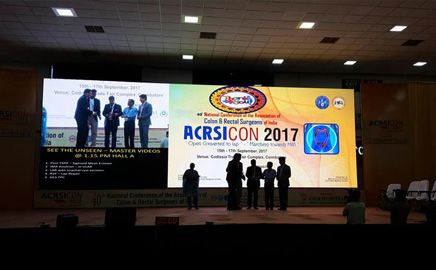
Own best video award.
40th National Conference of the Association of Colon & Rectal Surgeons of India
read more
Received fellowship in liver transplantation.
Received fellowship in liver transplantation.
read more
Received best e-video award.
26th Annual Conference of Indian Association of Surgical Gastroenterology.
read more